

The Challenge: From Soil Complexity to Practical Insights
Soil microbes are the unsung heroes of agriculture. They recycle nutrients, promote plant growth, and help crops respond to pathogens and stress. Yet, soil is one of the most complex and least understood ecosystems on Earth, and much of its microbial potential is still untapped. We face urgent agricultural challenges in feeding a growing global population, reducing dependence on synthetic chemicals, and maintaining productivity under the pressures of climate change. To meet these grand challenges, we need a deeper understanding of soil microbes and how to mobilize them for good.
Genome sequencing has greatly advanced our knowledge of soil microbial communities in recent decades. We can now map reference genomes of complex crops and identify soil microbes down to the strain level. Metagenomics can even suggest what these microbes might be capable of, although this is typically predictive of possible functions, rather than telling us what is actually happening in these populations.
Thus, the critical questions that remain are functional, such as:
- How do microbial communities respond to changing soil conditions?
- Which microbes can mobilize nitrogen or solubilize phosphate?
- Which strains will be robust enough to thrive in the field as biofertilizers or biopesticides?
- Which microbes have potential uses for bioremediation, for breaking down pesticide and herbicide pollutants from soil?
That’s where Biolog’s phenotyping technology comes in. It bridges the gap between sequencing data and agricultural outcomes, giving researchers, land managers, and industrial product developers actionable insights.
Biolog’s Toolkit for Sustainable Agriculture
Phenotyping reveals real-world microbial activity — carbon source utilization, nitrogen mobilization, stress tolerance, nutrient metabolism, and more — through microplate assays that generate functional fingerprints of microbial isolates and communities.
Here are four Biolog phenotyping tools that are essential to sustainable agriculture science:
EcoPlates™
Healthy soils depend on the diversity and strength of their microbial communities. But how do you measure what’s happening at the functional level? Biolog’s EcoPlates provide a window into soil community metabolism. By testing carbon source utilization across 31 carbon sources simultaneously – encompassing carboxylic acids, amino acids, and more – EcoPlates reveal the richness of microbial communities in your samples and the diversity of their functions. These insights can be incredibly valuable for:
- Community-level physiological profiling (CLPP)
- Monitoring temporal or spatial changes in microbial community activity
- Observing changes before and after a perturbation
- Metabolic community fingerprinting
- Assessing the level of metabolic stress in microbial communities
- Screening community diversity / similarity
- Monitoring changes in community functional diversity
publication Highlight
See how researchers used EcoPlates to assess soil quality changes in response to inoculants containing plant growth promoting bacteria (PGPB).
RhizoPlates™
If you’re looking to better understand the microscopic workings of the rhizosphere or leverage such insights to develop products like biofertilizers, then Biolog’s RhizoPlates makes this easier than ever. These specialized phenotyping microplates provide a targeted and easy-to-use solution for detecting, ranking, and monitoring nitrogen-fixing & phosphate-solubilizing bacteria (NFB/PSB) within the rhizosphere. In just days, you can screen soil isolates for the traits that matter most in sustainable agriculture, helping quickly find the candidates best suited for biofertilizer development and crop inoculants. RhizoPlates also support complex community analysis and monitoring microbial persistence in soil over time.
Phenotype MicroArrays™ (PM plates)
Do you want a deep view into the physiology of microbial isolates from soil samples? Or perhaps you need to understand how an organism behaves under various environmental conditions? In a single experiment, PM plates allow you to measure thousands of phenotypes spanning nutrient utilization, stress tolerance, and chemical sensitivities. When it comes to sustainable agriculture, this means you can:
- Identify and rank strains with advantageous traits
- Characterize metabolism relevant to plant-microbe interactions
- Optimize microbial candidates for field applications
- Understand your strains’ (and communities’) functional niches
publication Highlight
See how researchers evaluated five cellulolytic bacterial strains for their ability to decompose crop residue, using PM plates to characterize the strains across 106 carbon sources and multiple pH conditions.
Odin™ platform. Soil microbes are complex, but studying them at scale doesn’t have to be. The Odin platform combines powerful phenotyping capabilities – automatically incubating and reading up to 50 microplates per run – with advanced analytics to profile microbial growth and metabolic activity in real time across thousands of conditions.
With Odin, you can:
- Get rich insights into microbial physiology while saving time and resources
- Perform pairwise comparisons with a range of kinetic parameters
- Run large-scale ecological surveys efficiently
- Rapidly screen microbial candidates to identify the most resilient strains for biofertilizers, biopesticides, and soil amendments
- Optimize efficacy in bioprocessing production
The future of sustainable agriculture lies in unlocking the potential of soil microbes. By equipping researchers with tools to measure not just “who” is present but also “what” they do, Biolog is excited to help chart a path toward a more resilient global food system and a healthier planet.
Want to Learn More? Explore Biolog’s Sustainable Agriculture Resources:

Read Application Note
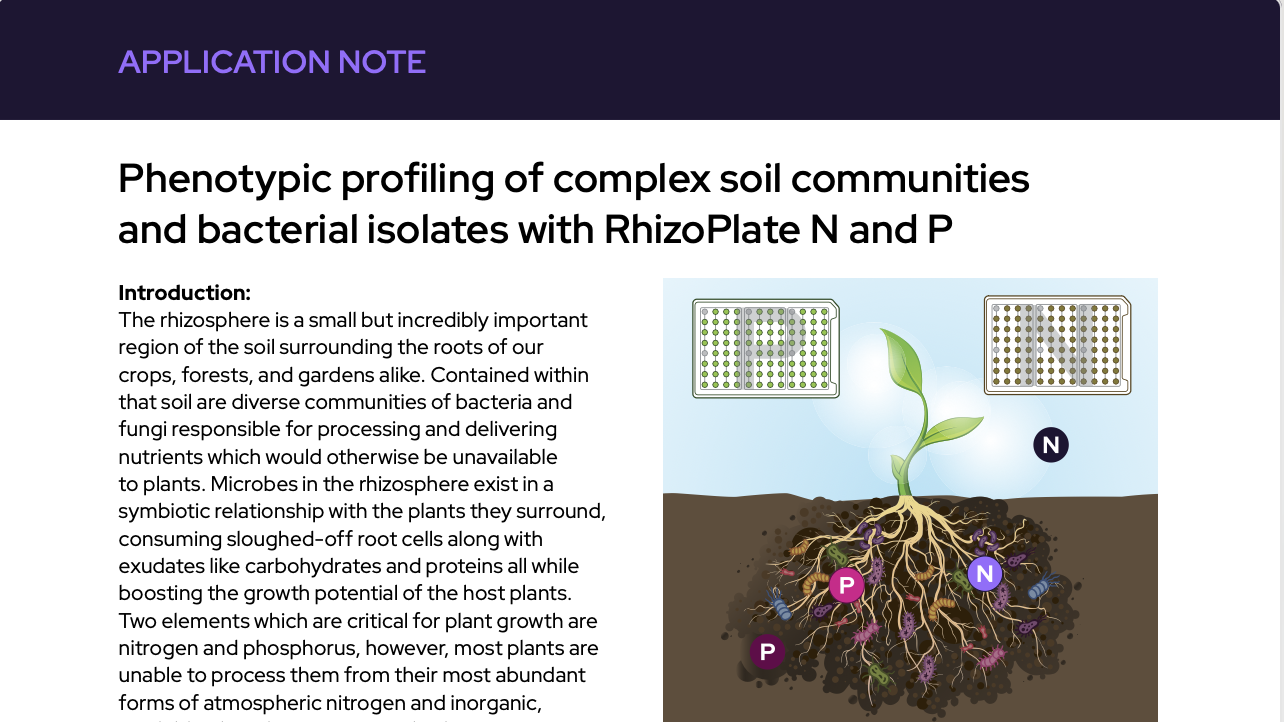
“Phenotypic profiling of complex soil communities and bacterial isolates with RhizoPlate N and P”
Connect with a Biolog expert

Connect with a Biolog expert to discuss you research and how phenotyping can help