
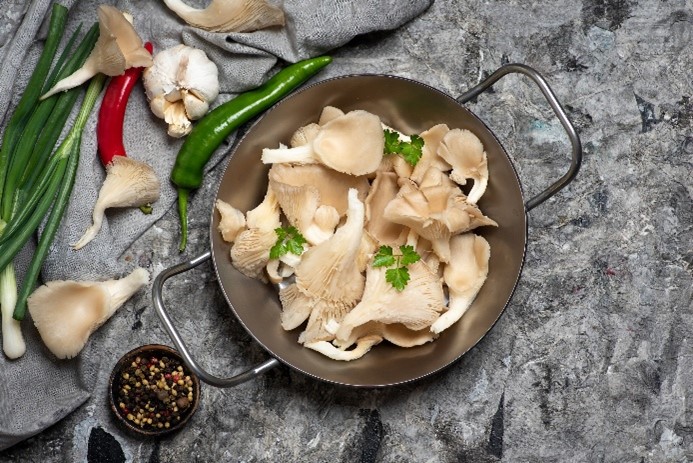
As the world turns to fungi as a source of more sustainable and protein-rich food, researchers are paying closer attention to how mushrooms grow and what they eat.
In a recent paper entitled “GastronOmics: Edibility and safety of mycelium of the oyster mushroom Pleurotus ostreatus”, scientists explored whether the mycelium of the popular oyster mushroom could serve as a safe, nutritious, and palatable new food source. While the fruiting body of P. ostreatus is already widely consumed, much less is known about the potential of the mycelium.
To better understand its growth behavior and optimize production methods, the researchers turned to Biolog’s Phenotype MicroArray (PM) plates and high-throughput instrumentation to unlock the organism’s industrial food potential.
Using PM 1 and PM 2, a subset of plates containing an array of sole carbon sources in each well, the team profiled the ability of P. ostreatus mycelium to utilize nearly 200 different carbon sources. If the organism is able to metabolize the substrate in a given well, it reduces Biolog’s proprietary redox dye, producing a measurable colorimetric change. This makes it easy to assess metabolic rates as well as growth and substrate preferences in a high-throughput manner, particularly when paired with the Odin™ system for automatic incubation and kinetic reads. Odin software is also packed with highly valuable kinetic analysis tools to thoroughly capture the phenotypic profile of any microorganism.
The researchers inoculated the plates with P. ostreatus M2191 mycelia and used glucose as the baseline control. As glucose is typically considered to be the gold standard substrate for fungal growth, they normalized growth responses for all the other substrates relative to the growth on glucose. And what they discovered was surprising – several alternative carbon sources actually produced higher growth!
Cellobiose, maltotriose, salicin, arbutin, butyric acid, sebacic acid, D-galacturonic acid, glycogen, dextrin, and pectin were among the high-performing substrates, suggesting that these could serve as preferred or more efficient carbon sources for potential large-scale mycelial cultivation (Fig. 4b)
This information is very important for industrial applications. Mycelium-based food products are often grown in liquid culture or fermentation systems, and glucose can be expensive or inefficient at scale. Identifying more cost-effective or better biomass-promoting alternatives gives producers flexibility and enhances sustainability.
These findings demonstrate how Biolog PM assays can help researchers screen fermentation media, support substrate switching strategies to lower production costs, help optimize yield for novel food ingredients, and even evaluate strain-to-strain variability in metabolic and growth preferences.
In addition to performing functional metabolic profiling, the study comprehensively evaluated the safety and nutritional value of P. ostreatus mycelium. No regulated mycotoxins were detected in either the fruiting body or the mycelium. Importantly, peptide toxins naturally occurring in P. ostreatus (Ostreatin, Ostreolysin, and Pleurotoxin A/B) were found at lower levels in mycelium than in the safe-to-eat fruiting body. The mycelium contained a range of health-promoting secondary metabolites, and in silico analysis predicted a low potential for allergenicity. Nutritional profiling revealed a composition comparable to the fruiting body, including key amino acids, though some variability was observed depending on the growth substrate.
To highlight its culinary appeal, the researchers partnered with The Alchemist, a restaurant in Copenhagen with two Michelin stars. A dish featuring P. ostreatus mycelium was served to a consumer panel, who found it appealing – marking a major step forward in consumer acceptance of mycelium-based foods.
This study exemplifies how Biolog’s functional phenotyping tools enable scientists to move beyond genomics and into functional, growth-based insights that can inform product development and practical scale-up strategies.
By identifying the most effective carbon sources and revealing how metabolic activity shifts with different nutrients, Biolog technology played a pivotal role in advancing the study. Researchers were able to boost mycelium yield, uncover cost-effective strategies for fermentation, and gain valuable insights into how growth substrates influence the nutritional composition of the final product. These findings ultimately support the development of safe, scalable, and nutritionally rich mycelium-based foods.
Contact us today to discuss how you can leverage Biolog’s functional phenotyping tools to characterize your own microbes of interest.